
Protect the root ball
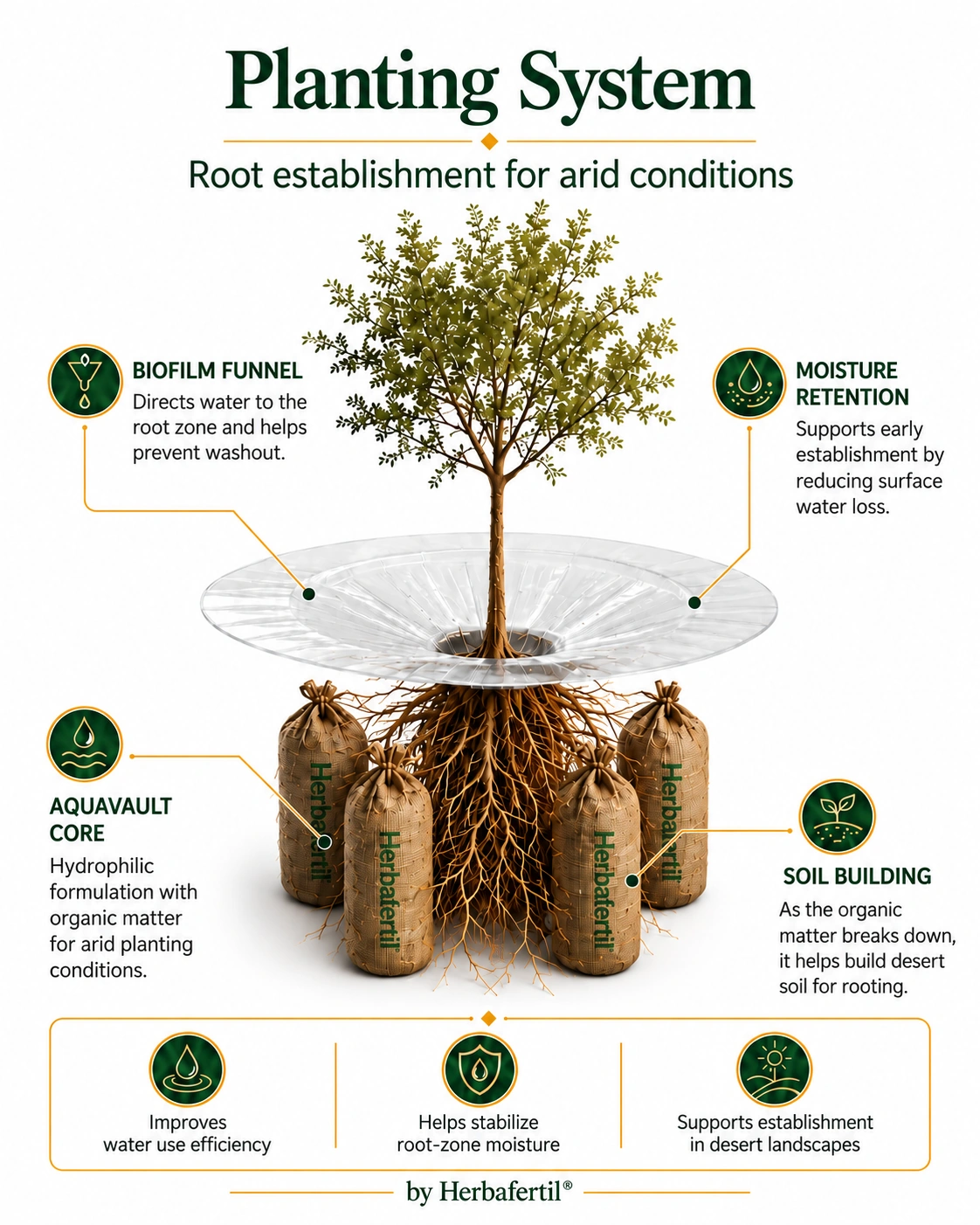
The protective biofilm cover limits surface heat and evaporation, helping prevent the root ball from overheating.
Field-tested planting by HerbaFertil®
AquaVault is a tree-planting system specifically developed and tested for arid and semi-arid conditions. It is designed to retain soil moisture and interrupt the capillary rise of salts, creating a stable, protected root zone for tree establishment and survival.
How the system works
A protected root zone means less exposure to heat, less moisture loss and more stable conditions for roots and soil life.
The protective biofilm cover limits surface heat and evaporation, helping prevent the root ball from overheating.
Directed irrigation and moisture retention keep water near the roots. The system is designed to interrupt the capillary rise of salts.
More stable moisture and temperature create favourable conditions for beneficial microorganisms and active roots.
HerbaFertil, rooting space and deep watering work together to support establishment and continued tree growth.
From root zone to urban shade
Our root-zone systems support the tree establishment and survival needed to create lasting urban shade. AquaVault brings this approach to arid and semi-arid landscapes.
Plan your planting project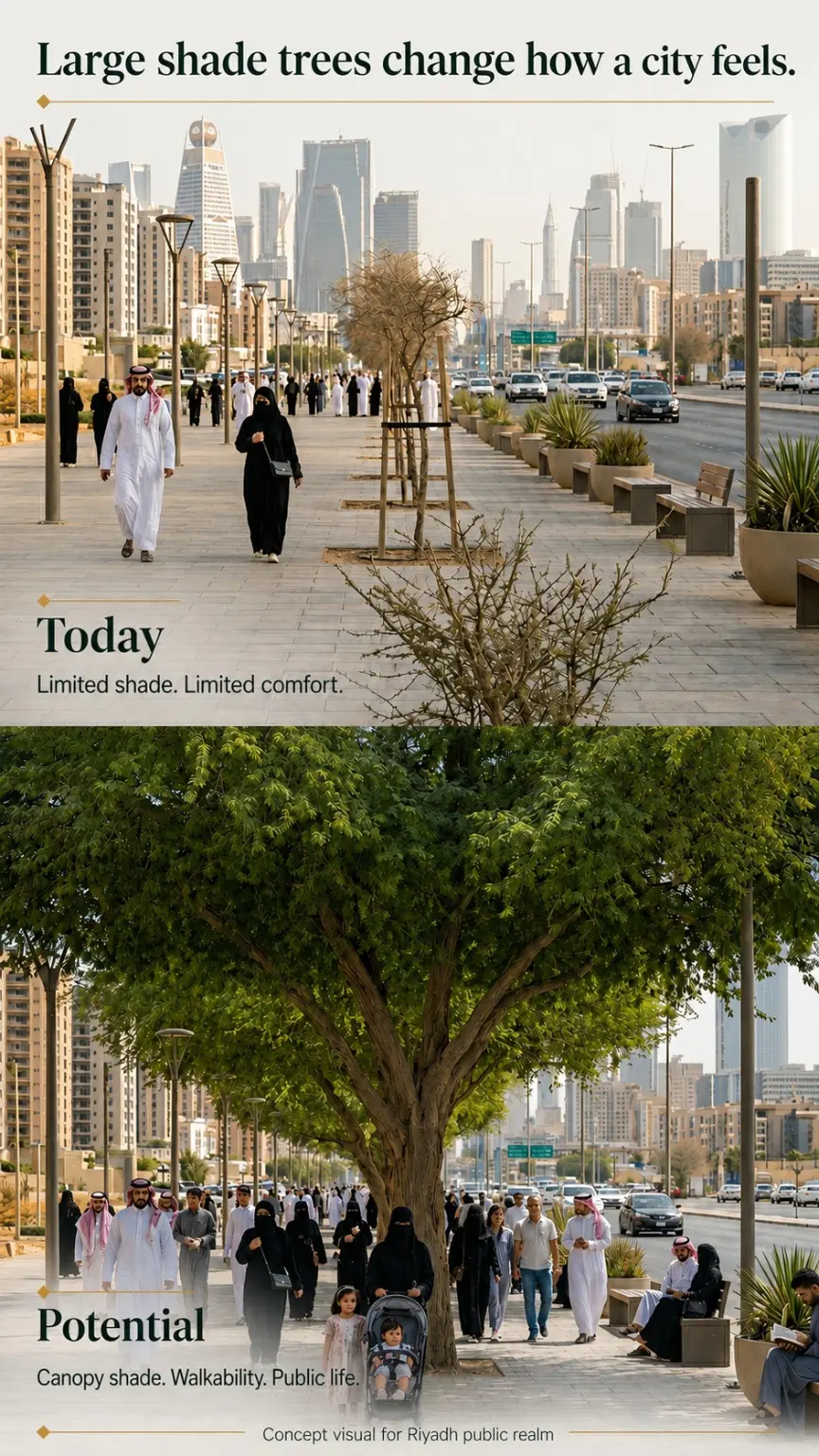 RIYADH / CONCEPT VISUAL · NOT A COMPLETED PROJECT
System design
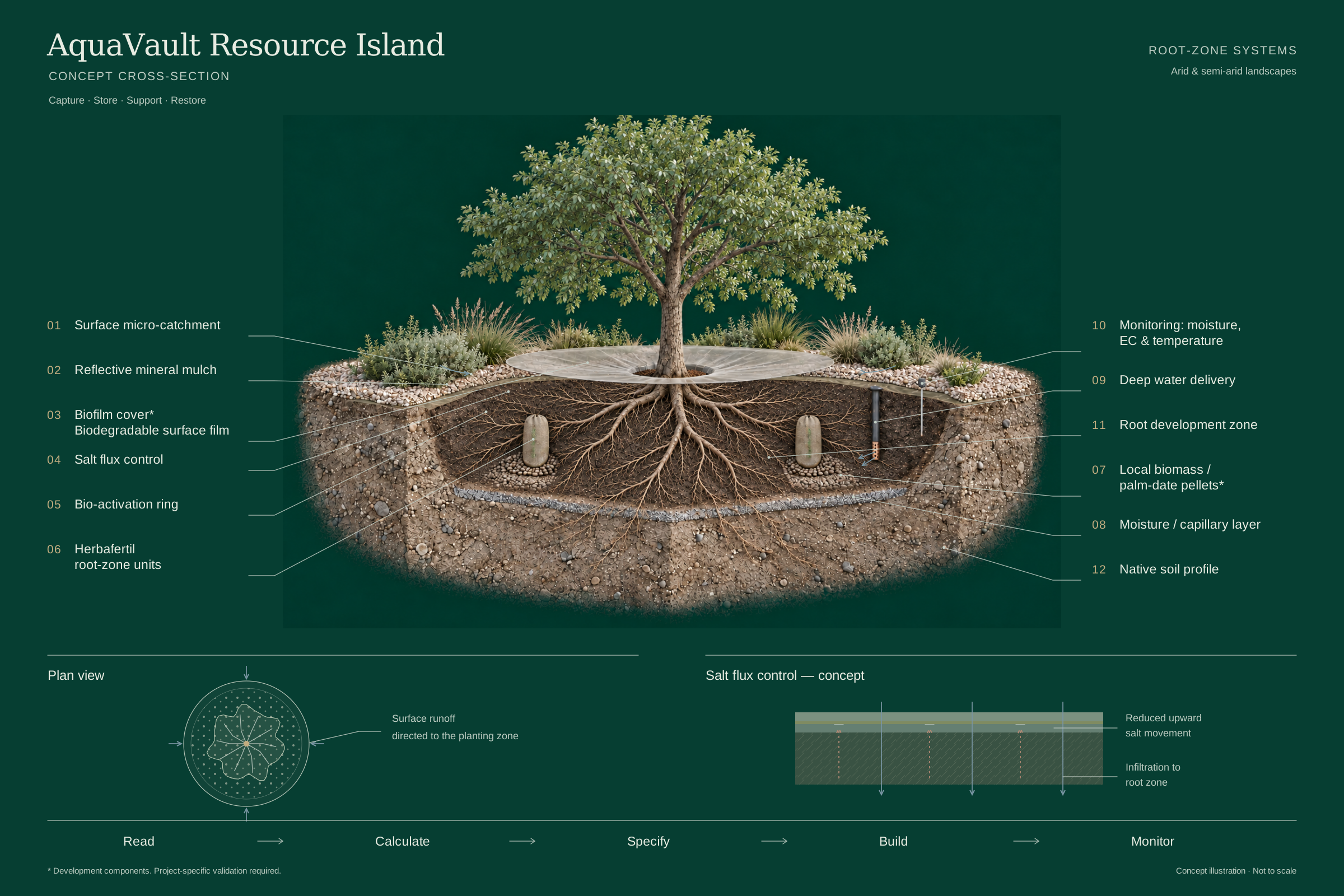
See how the components work together around one tree. The configuration is adapted to the site, species, soil and water supply.
 View full drawing ⤢
Illustration labels: English. The component guide below is available in your selected language.
A shallow basin collects rainfall and runoff from the surrounding surface and directs it towards the planting zone.
Light-coloured gravel or mineral mulch protects the surface and is intended to limit heating and evaporation.
A thin soil-biodegradable layer is being explored to reduce evaporation and moderate salt accumulation. Material selection and validation are part of development.
A functional layer designed to limit upward salt movement while allowing water to infiltrate towards the roots.
Organic and mineral amendments support soil biological activity around the developing root system.
Herbafertil units are placed within the active root zone to support soil structure, aeration and nutrient availability.
Locally sourced biomass, including palm and date residues, is a potential input for soil-building pellets. Formulation, testing and quality assurance are required.
A porous layer intended to retain moisture and support capillary water movement towards the root zone. Its specification depends on the local soil and water regime.
The concept shows deep water delivery through a protected perforated tip. Where SOS Bubbler is used, its reservoir stays above ground and connects to the below-ground delivery system.
A monitoring point records soil moisture, electrical conductivity (EC) and temperature to inform follow-up and irrigation decisions.
The root-development zone is intended to provide moisture and aeration for fine roots and structural roots.
The existing soil profile forms the foundation of the installation. The system is configured to work with local soil conditions.
Development components require project-specific testing and validation. This concept illustration is not a construction specification.
Bring AquaVault to your project
We help define the system, installation and monitoring, with a clear comparison of water use and tree establishment.
Review tree species, soil texture, salinity, drainage, water quality and irrigation availability.
Select the root-zone components and integrate them into the planting and irrigation design.
Compare with a defined conventional planting approach. Record water input, soil conditions and establishment over an agreed period.
Technical questions
AquaVault is a tree-planting system specifically developed and tested for arid and semi-arid conditions. It is designed to retain soil moisture and interrupt the capillary rise of salts, creating a stable, protected root zone for tree establishment and survival.
Directed irrigation, moisture retention and the protective biofilm cover reduce water losses around the root ball, with water savings of up to 80%.
AquaVault is designed to interrupt the capillary rise of salts. Moisture retention and surface protection work together to maintain favourable conditions around the roots.
It can be integrated with drip irrigation, deep-root watering, treated water systems, sensors and automated irrigation controls. The connection and water quality must be checked within the project design.
The system can be adapted to native, ornamental and urban tree species, as well as sandy, compacted, dry or moderately saline soils. Each installation is designed according to local conditions.
Yes. We recommend a monitored pilot comparing AquaVault with conventional planting, measuring tree survival, water use, soil moisture, temperature, salinity and canopy development.
AquaVault / Project enquiry
Share the site, planting programme and water conditions. We can discuss the configuration, a technical brief and a monitored pilot.
Request information